

Circular construction, ensuring materials are reused, refurbished, or recycled and that buildings are designed for longevity, adaptability, and deconstruction, is a relatively new concept but one that could significantly reduce the impact of our industry.
The construction industry produces 62% of the UK’s waste and 32% of all waste sent to landfill. Additionally, embodied carbon from the construction and refurbishment of buildings currently makes up 20% of all UK built environment emissions. As such, it’s clear that something needs to change and circular construction might just have the answers.
Here, our head of construction sustainability, Hattie Emerson and regional construction director, David Wellwood, discuss how this approach could work in London, the barriers to adoption and the steps we’re taking at McLaughlin & Harvey.
Why London is the right place to pilot circular construction
“The London Plan is one of the first pieces of legislation in England which requires consideration of a circular construction approach. It puts these principles at the heart of designing new buildings, requires that they be more easily adapted or dismantled and prioritises retaining existing buildings over demolition. The London Plan also requires a Circular Economy Statement to be submitted at the planning application stage and the same again on completion, which details progress against targets and commitments.
“As a result of the London Plan, there is greater awareness of the concept of circularity and a move towards the refurbishment of existing buildings. Additionally, we are increasingly seeing it referenced in tenders as awareness of the concept grows amongst clients.
“Given the volume of projects taking place across the capital, London is an ideal location for urban mining, coupled with the benefits of keeping materials local and the prevalence of ESG funders in the city, it makes sense to use it to test out circular construction approaches, which can be rolled out across the UK.” – David Wellwood
Circular construction in practice: how McLaughlin & Harvey is adopting it
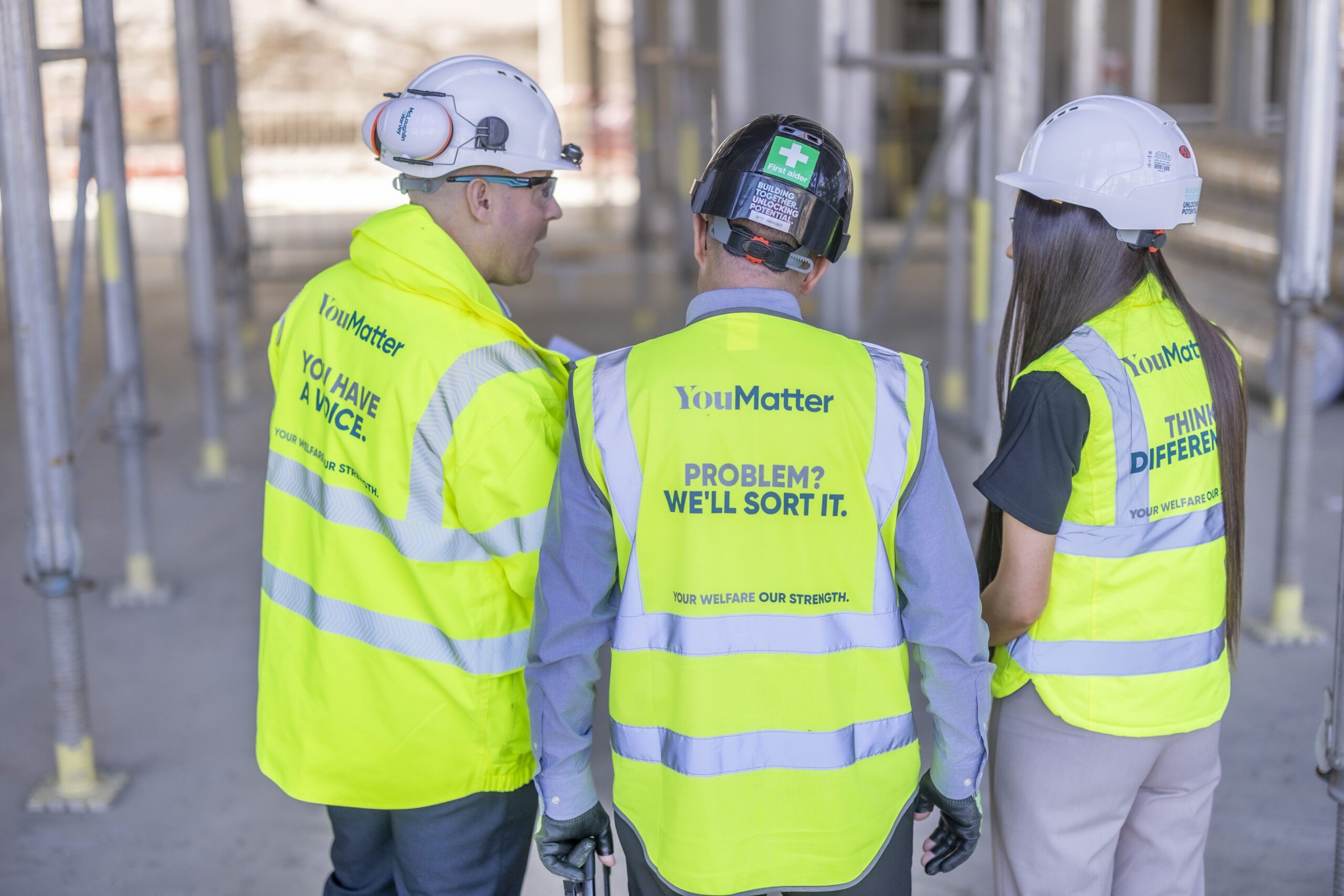
“Given that circular construction is in its infancy, most contractors are still researching the best ways to adopt this approach. At McLaughlin & Harvey, we consider both temporary works and the final design. For example, we transfer items such as glass partitions and furniture between projects as site welfare set up, this avoids disposal of functional equipment and also removes the need to procure new.
“Where it has been determined that a building is not viable for refurbishment, a Pre-Demolition Audit is carried out to report on what’s in the building and where materials can be saved and utilised for the new building or on another project. We review this in detail and against the final design to identify on-site and off-site reuse opportunities.
“I also lead a crowd-funded pilot project called Project Reuse through the Finishes and Interiors Sector, which is developing systems that will make it easier to access and reuse good-quality fit-out products, such as ceiling tiles and lighting fixtures.” – Hattie Emerson
Barriers to adopting circular construction in the UK
“There are several reasons why circularity has not yet been widely adopted across our industry. It needs to be committed to at the earliest stages in the client’s brief, embedded in procurement and protected throughout the design and construction phases.
“We also find that, often, buildings have already been stripped out when we get involved as a main contractor, meaning that the opportunity to save materials has already been missed. As such, it’s fundamental that this is considered from the outset and that an audit on what can be given a second life is carried out before the strip out begins.”
On-site logistical challenges: storage, quality and supply
“Practically, there are barriers for on-site teams, too. There is often little space to store materials which have been removed and marked for reuse and if materials are going to be used, project teams need to be satisfied that these will meet the right quality requirements and be available when needed to avoid delays. As such, there is work to be done on creating processes which can ensure this is the case. The growth of marketplace platforms is a good step towards improving this.
“Aspects such as door furniture and lighting fixtures are ideal materials for reuse, as they’re small, easier to extract and durable. However, often designs are not flexible enough to allow for reusing materials or there is a view that they are second-rate to new ones.”
Designing for deconstruction: rethinking how buildings come apart
“Most buildings that exist today have not been built to be deconstructed. For example, the use of glues and grout makes it difficult to extract materials and logistically, bigger elements can be challenging to remove from a building in a way that means they can be used again. As a result of this, there is a push towards designing for deconstruction and thinking about how a building can be taken apart, adapted or mined for future reuse from the outset, which is a key element of circular construction. Where non-standard products are specified, this dramatically reduces the chances of a second life after that installation, particularly where they are integrated with another bespoke product (e.g. bespoke luminaires integrated with a non-standard ceiling system).” – Hattie Emerson

What would make circular construction easier to adopt?
Material passports: tracking building material lifecycles
“Material passports are one suggestion that has been tabled for making it easier to trace the lifecycle of products, but this has not yet been widely adopted. Whilst several platforms have been developed to facilitate this, there may be less intensive ways to make this a reality. For example, incorporating data into BIM models or extending O&M manuals.”
The case for a UK-wide circular construction standard
“There’s also a lack of regulation outside of The London Plan and The Circular Economy (Scotland) Act 2024, meaning there is less of a driver for this approach to be adopted regionally. A form of national standard or Publicly Available Specification (PAS) which demonstrates what good looks like would help to encourage greater consideration of circularity.”
Manufacturer responsibility and the construction supply chain
“EU regulation is putting more onus on manufacturers to take responsibility for their products after supplying them, whether through maintenance or taking them back to be refurbished and redistributed. Manufacturers know their products better than anyone, so they are best placed to work with designers and contractors to develop ways for them to be reused and recycled.” – David Wellwood
Bio-based and natural alternatives to carbon-intensive materials
“Beyond looking at how we can reuse and recycle materials, for the construction industry to really reduce its impact on the environment, we must also consider whether building materials could be replaced by less carbon-intensive alternatives in the first place. For example, there are bio-based insulations, stud alternatives and many lower-carbon, natural options which can be used in place of what we have become reliant on as an industry.
“At McLaughlin & Harvey, we’re in the early stages of exploring whether clay, which is extracted for the creation of basements, could be dried out to create earth bricks in place of concrete blocks, providing a fully circular, low-energy alternative. We are also keeping an eye on developments around using stone as a structural material in place of concrete.” – Hattie Emerson
Driving the shift to circular construction across the UK industry
“It’s not just about our sustainability teams having a passion for making a change; the whole business must be on board with prioritising circularity to make a tangible difference across projects, as is the case at McLaughlin & Harvey. As further legislation is introduced and processes are put in place to make the reuse of materials easier, awareness of the concept will grow, alongside an appetite for thinking outside of the norm and doing something different.” – David Wellwood
FAQs
Circular construction is a building approach centred around designing buildings for longevity, adaptability and disassembly and prioritising the reuse and recycling of materials and structural components.
The UKGBC has defined circular economy principles for construction, which include maximising reuse, designing for optimisation, use standardisation, products as a service and minimising impact and waste.
Circular construction is still a relatively new concept in the UK, but some existing projects which have taken this approach include Wood Wharf in London and the UK’s first Circular Construction Hub in London’s Royal Docks, which will help ensure that construction waste is reused and recycled.
Designing for deconstruction, also known as designing for disassembly, is the concept of designing buildings in a way which means they can be taken apart, recovered and re-used at the end of their lives.
Any building products can be reused if disassembly has been considered during design and construction. This includes structural steel, brickwork, partitioning, flooring solutions, ironmongery, doors, ceiling tiles, sanitaryware and light fittings.